Paren Teens

Raising Healthy and Happy Teens in the Digital Age

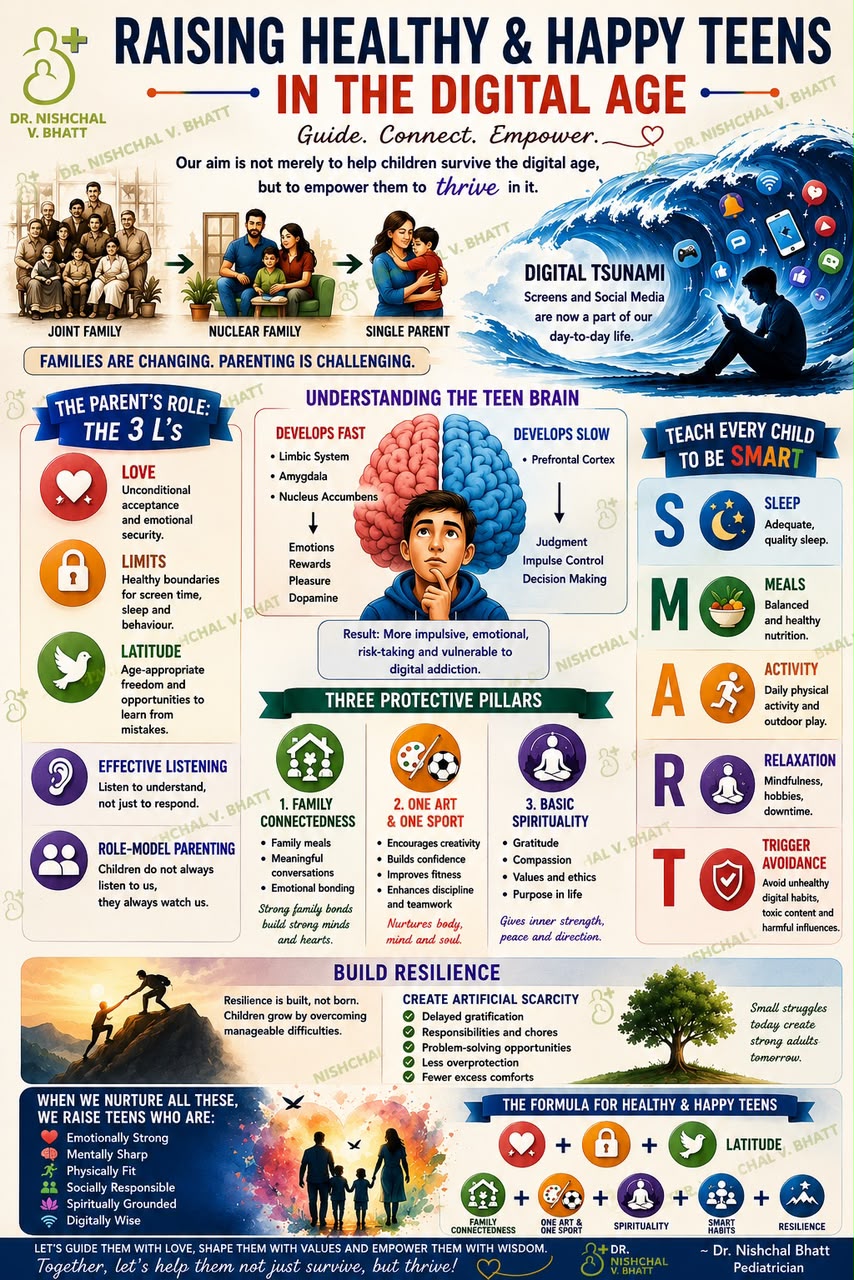
We are living in an era of tremendous social transformation. Society has evolved from large joint families to nuclear families and now, increasingly, to single-parent households At the same time, we are experiencing a digital tsunami. where smartphones, social media, gaming, and the internet have become an inseparable part of our day-to-day lives.

Understanding the adolescent brain is essential in raising healthy teenagers.


The teenage brain develops unevenly. The limbic system, amygdala, and nucleus accumbens which are responsible for emotions, rewards, and pleasure-seeking behaviors, mature much earlier. However, the prefrontal cortex—the judgment and decision-making center of the brain—takes much longer to fully develop.

Underarm (Axillary)
1. More impulsive.
2. More emotionally driven
3. More prone to risk-taking behaviors

Therefore, digital addiction can develop rapidly during adolescence.

The Critical Role of Parents
Parents play a pivotal role in guiding teenagers through this challenging phase. Effective parenting in the digital age can be summarized by the 3 L’s:
Love. Provide unconditional love, acceptance, and emotional security.
Limits. Set healthy boundaries regarding screen time, sleep, and behavior.
Latitude. More prone to risk-taking behaviors

In addition, parents should practice:

Effective listening
Empathy
Role-model parenting

A child older than 6 months of age who has a temperature below 101 degrees Fahrenheit (38.3 degrees Celsius) probably does not need to be treated for fever, unless the child is uncomfortable. Observe her behavior. If she is eating and sleeping well and is able to play, you may wait to see if the fever improves by itself.

Because children often do not do what we say—they do what they see.

Three Protective Pillars for Every Child

1. Family Connectedness. A strong emotional bond with family is one of the most powerful protective factors against anxiety, depression, addiction, and risky behaviors.
2. One Art and One Sport. Every child should be encouraged to pursue: .
One creative activity (music, dance, painting, drama, etc.)
One physical activity or sport.
These activities improve self-esteem, emotional regulation, discipline, and resilience.
3. Basic Spirituality .
Spirituality does not necessarily mean religion. It means:
Gratitude
Compassion
Purpose in life
Mindfulness
Values and ethics
It helps children develop inner strength and emotional balance

Teach Every Child to be SMART

S – Sleep. Adequate and quality sleep.
M – Meals Balanced and healthy nutrition.
A – Activity Daily physical exercise and outdoor activities.
R – Relaxation Mindfulness, hobbies, meditation, and downtime.
T – Trigger Avoidance Avoid unhealthy digital habits, toxic content, and harmful peer influences.

Building Resilience

Resilience is perhaps the most important life skill of the 21st century.
Children become resilient not by being protected from every difficulty, but by learning to face challenges.


One effective strategy is Artificial Scarcity

Delayed gratification
Assigning responsibilities
Limiting excessive comforts
Encouraging problem-solving and independence.

Small struggles today prepare children for bigger challenges tomorrow.

Take-Home Message

To raise healthy and happy teens in the digital age, we must provide:
Love
Limits
Latitude

Along with:
Family connectedness
One art and one sport
Basic spirituality
SMART lifestyle habits
Resilience-building experiences.
If we nurture these foundations, we can empower our children not merely to survive the digital age, but to truly thrive in it.


Thank You.

Dr. Nishchal Bhatt
Pediatrician “Healthy minds create healthy futures.”.